Español – Eglish
In 1959, Fidel Castro did not conquer Cuba through elections, but in a political vacuum, with the help of U.S. politics, the CIA, and a compliant press. By the time the truth was known, it was already too late: the free press had disappeared, political parties were outlawed, opponents executed, and Cuba was linked to the Soviet Union.
This is the untold story of how Washington handed Cuba over to communism, and why Cuban Americans will never forget it. From the betrayal at the Bay of Pigs to the destruction of one of America’s most prosperous republics, this video exposes the cost of decades of ideological infiltration within the United States.
- We explore:
- The role of the U.S. Department of State and the CIA in promoting Castro as a «progressive reformer.»
- The abandonment of Cuban exiles at the Bay of Pigs.
- The transformation of Miami into a global center by the exile community.
- Why Marxist ideology is spreading today in the United States and why Cuban Americans are determined to stop it.
Transcription
To the liars, the apologists, and the history rewriters, we remember everything. We know because we lived it. We’re tired of being lectured about communism by people who never lived through it. We’re sick of being told our truth needs, you know, nuance. We’re insulted when we’re called privileged when we came here with nothing.
[Music] No food, no freedom, no future. The average Cuban in 2025 eats worse than the average slave in 1865 did under Spanish rule. And we rebuilt, working three, four jobs. Everyone studied. Everyone sacrificed. There were no handouts.
Cubans were completely dispossessed of everything they owned. Communists entered your home, did an inventory, and if anything was missing, you would not be given an exit permit, and you would be jailed. Every family keepsake stolen.
They mock the victims. They call us white privileged Cubans, Keystone extremists, right-wingers, obsessed. Can you imagine calling Jewish refugees Keystone Jews or mocking East Germans who fled over the Berlin wall? Only Cubans are treated this way. Only our annihilation is erased, mocked, and rewritten.
We watched as the world applauded Ukraine for resisting Russian tanks. But when we resisted Soviet tanks in the Escambre Mountains, they called us bandits. 7,000 Cuban freedom fighters were slaughtered. No help came, no movies. You never heard of this massacre. Nobody did. There were no Cuban flags on lapel pins in Congress. Half a million Cuban exiles in the US, and nobody listened. [Music]
Fidel Castro jailed more political prisoners per capita than Joseph Stalin during the Great Terror. He killed more Cubans in his first three years than Adolf Hitler killed Germans in his first six. He came closer than anyone in history to starting a nuclear war. He destroyed a nation that had a higher per capita income than half of Europe and turned it into a country that even the poorest in the region now flee with the highest suicide rate in the Western Hemisphere. and they still defend him.
We came here because there was no other choice. We were facing firing squads. We know because we were there. We didn’t flee because we lost elections. We fled because they banned elections. And when we tried to fight back, America betrayed us. [Music]
A century earlier, 17,000 United States troops defeated a decaying Spanish Empire in Cuba. But in 1961, the CIA sent 1,400 untrained exiles to fight a Sovietbacked regime and then left them to die.
One year later, that same United States government planned a full-scale invasion with 350,000 troops. Why? Because they knew the Bay of Pigs was never meant to succeed. They knew Castro was a Marxist as early as 1948, but they still let him take power.
The real threat is not what we say. The real threat is what we remember. And that is why they try to silence us. But we will not be silenced.
Because we remember that our loyalty to our beloved American neighbors has never wavered. Cuba has always stood for liberty, even when it wasn’t our own. More than 7,000 Cubans fought in the American War of Independence. And it was the women of Havana who raised the money that financed George Washington’s final campaign at Yorktown. But Cuba didn’t just send money. It helped change history. Through Spanish embassies in Havana and Madrid, it was Spanish Cuba that pressured the French crown to fully enter the war on America’s side. Without Cuba’s money, men, and diplomacy, the United States might not even exist. So kindly don’t tell us we don’t understand freedom. We helped pay for yours.
The United States intervened in Cuba in 1898, just months after Spain had already granted the island full provincial autonomy and a functioning internal government. Cuba was no longer a colony. It was governing itself. But the United States invaded anyway, replacing Spanish rule with American military occupation. And it didn’t stop there.
The truth is, Cuba had leaders who tried to modernize and build, and the United States tore them down. [Music]
President Gerardo Machado was never perfect, but his public works rivaled anything in the hemisphere. He built highways, schools, hospitals, ports, and national monuments that still stand today.
But in 1933, the United States sent diplomat Sumner Wells to Havana and forced Machado out. Snar Wells’s intervention ended Cuba’s chance to evolve under a modern nationalist leader with infrastructure ambitions unmatched to this day. It was the first time Washington decided who could and couldn’t govern Cuba. It wouldn’t be the last.
And when Castro came, they didn’t force him out, they forced him in. [Music]
They say Castro was a revolutionary, but the truth is he was installed, not elected. Not one Cuban ever voted for Fidel Castro. His mandate didn’t come from the people. It came from Washington.
The United States refused to support any democratic alternative, cut off arms to the Cuban army, and helped publicly glorify Fidel through American media. The New York Times made him a folk hero. The State Department called him the future. And just six days after he marched into Havana without elections, without a constitution, and without any democratic legitimacy, the United States recognized him. They didn’t just tolerate Castro. They chose him. They armed him. They blessed him. And the Cuban people have been paying the price ever since.
And even now, from the comfort of Manhattan or Hollywood, American activists still glorify the regime that slaughtered us.
One of them, Sandra Levenson, director of the Center for Cuban Studies, touring a Havana psychiatric institution, upon learning that dissident were receiving forced labbotoies, once said, «If I had to choose between being subjected to a socialist labbotomy or being exposed to American television for a lifetime, I’d choose the labbotomy. That’s the sickness we’re up against.» They cheer for the brainwashing of others while never sacrificing their own freedom. [Music]
And this sickness isn’t hidden anymore. It wears a smile and holds office.
The current mayor of Los Angeles, Karen Basque, once called Fidel Castro’s death a great loss to the people of Cuba. She was trained by a Cuban front group known as the Vinceos Brigade, promoted by Cuban intelligence to brainwash American youth. And now she runs the second largest city in the United States. [Music]
In January 1959, Washington told the world it could not interfere in Cuba’s politics. That was a lie.
For decades, the United States had done exactly that.
In 1933, Ambassador Sumar Wells forced President Machado out and installed his own choice.
In 1952, it instantly recognized Batista’s coup.
By late 1958, it had already pushed Batista to the door. Ambassador Earl T. Smith told Congress the United States was largely responsible for the fall of Batista.
We put Castro in power and they did it knowing Fidel Castro was a Marxist whose forces held less than 5% of the island. They rejected a Vaticanbacked democratic plan and in just 6 days gave an unelected rebel their blessing.
The price? Hundreds of thousands of Cubans executed, imprisoned, or disappeared. The destruction of one of the most prosperous economies in the Americas. A nation once richer than Spain, freer than most of Europe, and a magnet for immigrants.
The betrayal didn’t end there.
In April 1961, 1,400 Cuban exiles, the Bay of Pigs Brigade, landed to free their homeland.
They had been promised US air support. But once they were already on the beaches, President John F. Kennedy invoked the same old excuse, «We cannot intervene.» Claiming it would appear interventionist. It was a bald-faced lie. For decades, the United States had intervened in Cuba whenever it suited its interest.
That day, the truth hit like shrapnel. There would be no American planes, no cover, no rescue. The mission was doomed, and brave men were left to fight and die alone.
And yet, the exiles who survived built something extraordinary.
In a twist of history’s irony, the very people the United States abandoned transformed Miami into the Wall Street of the South, the de facto capital of Latin America. Billions in Cuban capital rebuilt South Florida’s economy, creating one of the greatest immigrant-driven successes in US history.
It was a kind of Cuban operation paperclip. Except instead of rocket scientists, America absorbed the talent, industry, and entrepreneurial fire of an entire nation. And it all happened in a city, Miami, carved from land once governed by the Spanish Cubans, who had helped America win its independence from England.
In 1898, America did not annex Cuba. After 1959, it annexed Cuba’s grandchildren, the heirs of a proud republic, and concentrated them in one small corner of Florida.
There, they rebuilt, but they never forgot.
Cuba was not lost by defeat in battle. It was lost by betrayal and policy.
Why would the United States choose a communist regime? Surely that sounds like nonsense.
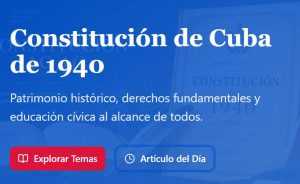
The State Department had full knowledge of a viable democratic alternative, the Vaticanbacked plan by Dr. Carlos Marquez Sterling, president of the 1940 Cuban Constitutional Assembly, to form a provisional government and hold free elections under Cuba’s 1940 constitution.
This plan had the support of the Vatican, several Latin American governments, and moderate Cuban factions. It would have prevented a power vacuum and kept Marxist radicals from seizing control.
Internal State Department records show Assistant Secretary of State Roy Rubot, writing on January 2nd, «We have decided to recognize the rebel government when they take Havana. Other claimments will not be considered legitimate.
The truth is simple. This was not naive misjudgment or principled restraint.» It was a calculated choice to hand Cuba to a communist dictator just 90 m from US shores.
So, how could this happen?
By the midentieth century, Marxists had already gained enormous influence inside the American system, inside the State Department, the CIA, the media, and the universities that trained future diplomats and policymakers.
These were not fringe voices. They formed an ideologically aligned class that gradually captured the cultural, diplomatic, and educational institutions of the United States, redefining what America would stand for abroad.
By the 1940s and 1950s, many US diplomats and foreign policy planners were Ivy League trained idealists steeped in European Marxist thought, Fabian socialism, and postcolonial theory. They viewed nationalism as a threat, American capitalism as imperialist, and central planning as protective of their interests.
This was the same mindset that lost China to Mao and infected Latin America policy. In that worldview, letting Castro have Cuba wasn’t a tragedy. It was history moving forward.
The State Department and CIA were not simply blindsided.
Whistleblowers like Whitaker Chambers, Elizabeth Bentley, and Earl T. Smith warned of pro-communist sympathies in high places. Many inside government saw Castro’s anti-imperialism as noble, preferring Marxist revolution over democratic reform.
Meanwhile, cultural elites in media and Hollywood sold the revolution to the public. The New York Times lionized Castro and Herbert Matthews’s glowing profiles. CBS and other outlets framed his insurgency as a people’s movement.
This rebranding of a communist rebellion into a romantic liberation story neutralized popular resistance to the betrayal of Cuba.
Cultural elites didn’t just cheerlead, they provided the protective smokec screen to postwar globalists.
A centralized socialist Cuba was more predictable and pliable than an independent capitalist republic.
A Batista successor like Marquez Sterling might have built a prosperous, nationally assertive Cuba that traded freely, rejected supernational controls, and inspired other Latin American nations to chart their own course.
That, not communism, was the real threat to their managed global order.
In short, the United States didn’t accidentally destroy Cuba to please the left-leaning elite. It empowered Castro because those elites were already steering policy. They were the architects of the betrayal and their influence still shapes western policy today.
America’s greatest strength, openness, had been weaponized against it, allowing ideological adversaries to write the scripts, teach the students, brief the diplomats, and guide the levers of power.
Cuba was not lost to communism by force of arms. It was surrendered from within by people who no longer believed in the very freedom they were sworn to defend.
The path forward begins with an official admission by the United States that it betrayed the Cuban Republic.
It must be followed by real action, restitution of stolen property, a Marshall Planstyle reconstruction of a free Cuba led by exiles and democratic institutions, and a truth and memory commission to record the regime’s crimes and honor its victims.
History will ask whether America told the truth and acted to repair the damage, or whether it let the same infection spread until it claimed both nations. The time for silence is over.